China Telecom earnings and guidance
MyStockButler's October 2026 analysis: Latest reported results show revenue fell 2.9% year on year, operating income fell 14.1%, and shareholder earnings fell 14.7%. Watch whether total investment stayed within the plan and whether reported profit reconciles with management’s adjusted growth claim.
What has China Telecom guided for 2026?
The share can reach HK$9.63 by October 2029 if earnings recover and cloud and AI investment produces adequate cash returns. Management plans 2026 capital expenditure of RMB73.0 billion, down 9.2%. Computing-infrastructure capex rises 26.0%, while network-infrastructure capex falls 26.0%. Cash-distribution guidance is 75% of profit attributable to shareholders, alongside longer-term growth in intelligence revenue and profit.
| Period | Low | High | Given on | |
|---|---|---|---|---|
| CAPEX | Year to Dec 2026 | 73,000 | 73,000 | Mar 24, 2026 |
| CAPEX change | Year to Dec 2026 | -9.2% | -9.2% | Mar 24, 2026 |
| Computing infrastructure CAPEX change | Year to Dec 2026 | 26.0% | 26.0% | Mar 24, 2026 |
| Network infrastructure CAPEX change | Year to Dec 2026 | -26.0% | -26.0% | Mar 24, 2026 |
| Profit distributed in cash (% of profit attributable to equity holders of the Company) | Year to Dec 2026 | 75.0% | Mar 24, 2026 |
What this means. The 73,000 million yuan is management’s planned capital spending, which may differ from the cash capital spending actually reported in the cash-flow statement.
Did China Telecom keep its dividend promise?
The dividend promise is easier to test. In 2023, management said the payout would rise above 75% of annual shareholder profit within three years from 2024. The payout reached 75% in 2025 and the first half of 2026, but the dividend per share fell in the first half of 2026 because profit fell. A fixed share of a smaller profit produces a smaller payment per share.
What is China Telecom’s revenue and profit trend?
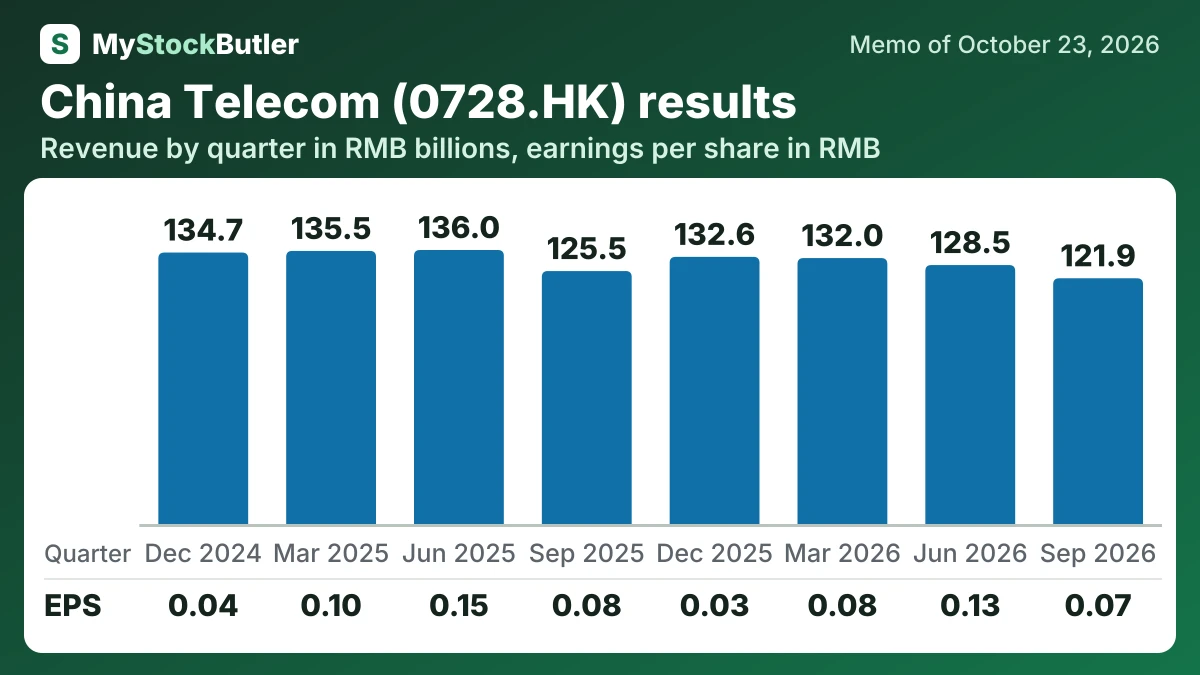
Third-quarter revenue fell 2.9% year on year. Operating income fell 14.1%, and shareholder earnings fell 14.7%. Profit therefore declined much faster than sales, which means the remaining revenue carried less margin. It was the third successive 2026 quarter with lower year-on-year earnings.
| Sep 2026 | Jun 2026 | Mar 2026 | Dec 2025 | Sep 2025 | Jun 2025 | Mar 2025 | Dec 2024 | |
|---|---|---|---|---|---|---|---|---|
| Revenue | 121,931 | 128,504 | 131,967 | 132,561 | 125,529 | 135,971 | 135,498 | 134,699 |
| Operating income | 7,897 | 14,828 | 8,151 | 1,935 | 9,190 | 17,801 | 10,748 | 3,419 |
| Net income | 6,619 | 12,238 | 7,350 | 2,412 | 7,756 | 14,153 | 8,864 | 3,713 |
| EPS, diluted | 0.07 | 0.13 | 0.08 | 0.03 | 0.08 | 0.15 | 0.10 | 0.04 |
What this means. The free cash flow number also subtracts lease payments, so it is lower than cash from operations minus equipment spending alone.
What should China Telecom investors watch next?
The 2027 budget will reveal how management responds to the first year of AI investment. Expansion backed by contracted customers would support the strategy; expansion accompanied mainly by larger capacity statistics would not answer the commercial question. The final dividend will also show what the payout commitment means in cash after pressure on reported profit.
Through the 2027 interim results, investors should follow a simple sequence: capacity installed, customers billed, cash collected, customers retained and profit left after delivery costs. A pilot or discounted first contract proves less than a renewal at an adequate price. Those tests lead directly to the question of how China Telecom will monetise its AI infrastructure.