Zoetis stock forecast 2027–2029
MyStockButler's October 2026 analysis: Zoetis’s weighted forecast reaches $85.85 in October 2027, with a +11% total return including dividends. It hinges on clinic demand, repeat prescriptions and cash generation recovering.
Where could Zoetis’s shares be by 2029?
The forecast gives Zoetis a positive expected return, but recovery is not assured. The weighted price reaches $85.85 in October 2027, $94.12 in October 2028, and $104.98 in October 2029, producing total returns of 11%, 24%, and 41% including dividends. The October 2029 range runs from $48.74 in the bear case to $168.40 in the bull case, against today’s $79.59.
The base case has the highest probability because it requires stabilization rather than a rapid rebound. The bear case carries 30% odds, the base 50%, and the bull 20%.
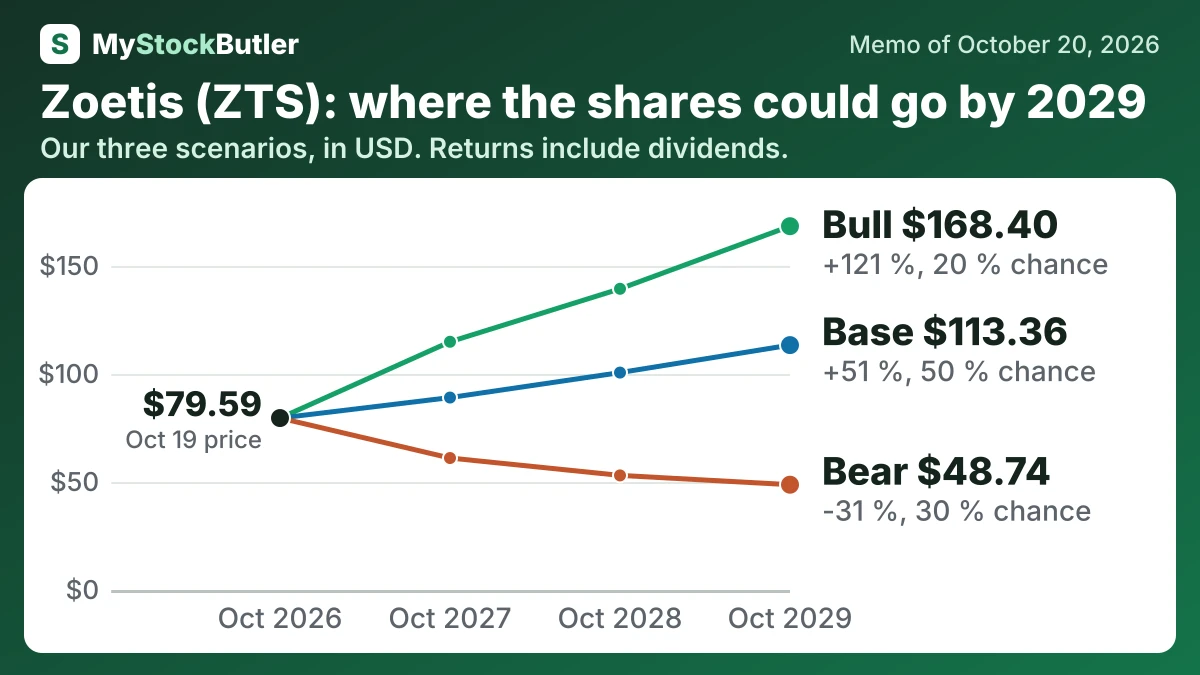
| Case | Probability | October 2027 | October 2028 | October 2029 |
|---|---|---|---|---|
| Bear | 30 % | 61.08 (-21 %) | 53.04 (-28 %) | 48.74 (-31 %) |
| Base | 50 % | 89.08 (+15 %) | 100.64 (+32 %) | 113.36 (+51 %) |
| Bull | 20 % | 114.90 (+47 %) | 139.42 (+81 %) | 168.40 (+121 %) |
| Weighted | 100 % | 85.85 (+11 %) | 94.12 (+24 %) | 104.98 (+41 %) |
What this means. The weighted row is a probability-adjusted average of the bear, base, and bull cases, not a guaranteed price.
What has to go right for Zoetis, and what could go wrong?
The bear case instead uses revenue of $9,000 million at the first date and $8,700 million at the last, with margins falling from 27% to 26%. That produces earnings of $2,430 million and $2,262 million because pet weakness, rebates, and competition persist. The bull case reaches $10,700 million of revenue and a 30% margin at the last date, producing $3,210 million if clinic demand, repeat prescriptions, Librela, and new launches recover. Recent U.S. pet sales fell 11%, dermatology fell 16%, and global Simparica was flat, so the bull case requires several improvements together.
The view would move toward the bear case if U.S. pet demand weakens further, rebates keep reducing realized prices, or Librela repeat use remains poor through FY2026–FY2029. Weaker cash generation and elevated debt would also reduce buybacks from FY2027 onward.
How much cash does Zoetis really make?
Stock-based compensation adds another owner-level question. Accounting adds the expense back to operating cash flow because no immediate cash leaves the company, but employees receive claims that can dilute shareholders. Deducting stock pay from free cash flow gives a more conservative owner-oriented measure. Disposal proceeds also need separation because cash from selling a business is not cash generated by the continuing portfolio.
| 2025 | 2024 | 2023 | 2022 | 2021 | |
|---|---|---|---|---|---|
| Cash from operations | 2,904 | 2,953 | 2,353 | 1,912 | 2,213 |
| − Capital spending | 621 | 655 | 732 | 586 | 477 |
| = Free cash flow | 2,283 | 2,298 | 1,621 | 1,326 | 1,736 |
| − Stock pay | 83 | 74 | 60 | 62 | 58 |
| = Real free cash flow | 2,200 | 2,224 | 1,561 | 1,264 | 1,678 |
What this means. The company's own free cash flow is higher because it does not subtract shares given to employees as pay, which reduce each shareholder's ownership.
What does an investor pay for Zoetis today?
| Today (Oct 20, 2026) | |
|---|---|
| Share price | 79.59 |
| P/E, last 12 months (calculated) | 13.1x |
| P/E, next 12 months (calculated) | 12.4x |
| Free cash flow yield (calculated) | 6.9% |
| Real free cash flow yield (calculated) | 6.7% |
| Dividend yield (calculated) | 2.7% |
What this means. The next 12 months price-to-earnings ratio uses analysts' guesses about future profit, so it can be wrong.