SpaceX stock forecast 2027–2029
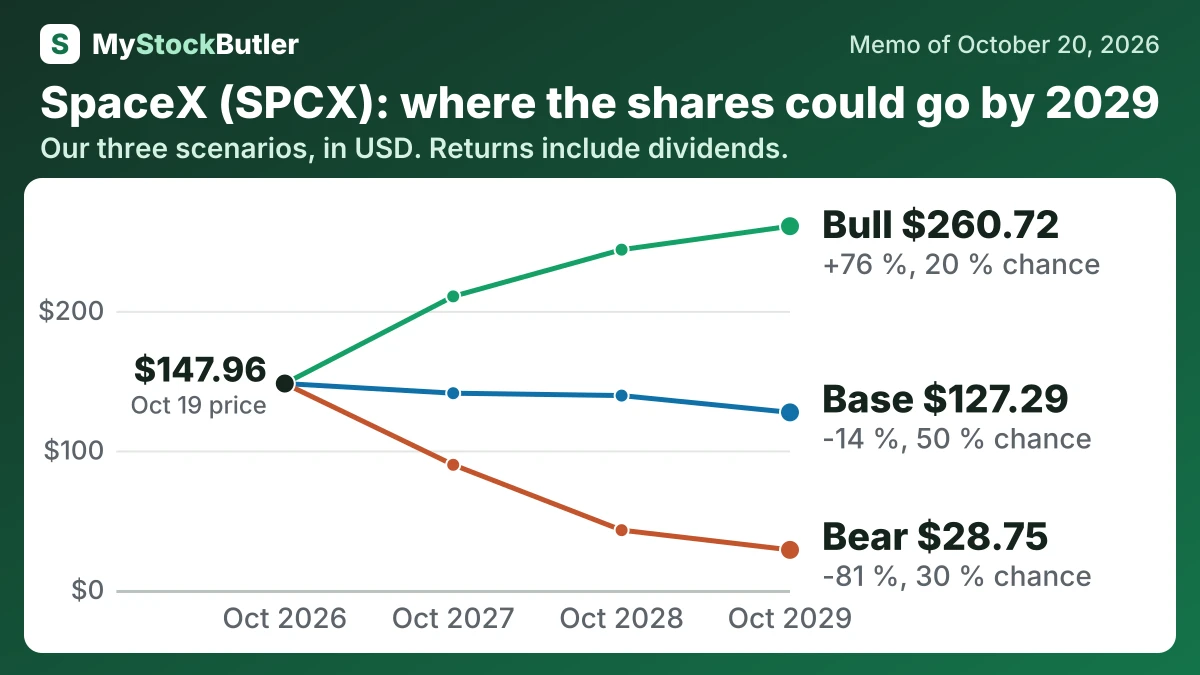
MyStockButler's October 2026 analysis: SpaceX's weighted scenario is $124.41 by October 2029, with 30% bear, 50% base and 20% bull. SpaceX's outcome hinges on cash conversion from compute, Starlink and Starship investment.
Where could SpaceX's shares go?
The weighted price is $139.51 in October 2027, a 6% negative return including dividends. It falls to $131.30 in October 2028, a negative 11% return. By October 2029, it reaches $124.41, a negative 16% return.
| Case | Probability | October 2027 | October 2028 | October 2029 |
|---|---|---|---|---|
| Bear | 30 % | 89.72 (-39 %) | 42.88 (-71 %) | 28.75 (-81 %) |
| Base | 50 % | 141.03 (-5 %) | 139.32 (-6 %) | 127.29 (-14 %) |
| Bull | 20 % | 210.43 (+42 %) | 243.90 (+65 %) | 260.72 (+76 %) |
| Weighted | 100 % | 139.51 (-6 %) | 131.30 (-11 %) | 124.41 (-16 %) |
What could make SpaceX's cases work or fail?
EBITDA is the operating growth engine. The base case uses $16,000 million in October 2027 and $22,000 million in October 2028. It reaches $29,000 million in 2029. This builds from roughly $9,300 million of annualized first-half EBITDA, the profitable Connectivity segment and the latest quarter’s sharp improvement. The bear case uses $12,500 million, then $10,500 million, before recovering to $12,000 million. It reflects falling Starlink ARPU, widening AI losses and underused capacity. The bull case reaches $20,000 million in 2027 and $30,000 million in 2028. It reaches $42,000 million in 2029 if contracted cloud sales become earned revenue and Starship improves capacity economics.
| October 2027 | October 2028 | October 2029 | |
|---|---|---|---|
| EBITDA | 16,000 (12,500 / 20,000) | 22,000 (10,500 / 30,000) | 29,000 (12,000 / 42,000) |
| Shares (millions) | 13,505 (13,703 / 13,308) | 13,843 (14,251 / 13,441) | 14,189 (14,821 / 13,575) |
| Dividends per share | 0.00 (0.00 / 0.00) | 0.00 (0.00 / 0.00) | 0.00 (0.00 / 0.00) |
| Enterprise value to ebitda | 120 (100 / 140) | 90.00 (65.00 / 110) | 65.00 (45.00 / 85) |
| Net debt | 15,400 (20,600 / -300) | 51,400 (71,400 / 21,700) | 78,900 (113,900 / 30,700) |
How much cash does SpaceX really make?
Subtracting stock compensation produces analytical “real free cash flow” of negative $16,068 million in 2025. Stock pay is not a second cash payment, but it transfers value to employees and can dilute owners. The central question is how much spending expands the network and how much merely replaces worn-out equipment.
| 2025 | 2024 | 2023 | |
|---|---|---|---|
| Cash from operations | 6,785 | 5,776 | 4,520 |
| − Capital spending | 20,906 | 11,163 | 4,415 |
| = Free cash flow | -14,121 | -5,387 | 105 |
| − Stock pay | 1,947 | 784 | 679 |
| = Real free cash flow | -16,068 | -6,171 | -574 |
What does an investor pay for SpaceX today?
That forecast is not the latest reported result. SpaceX recorded a net loss of $541 million in the second quarter of 2026. Its EV-to-revenue and price-to-book measures also signal that investors are paying heavily for each dollar of sales and accounting net assets. Its negative free-cash-flow yield means operations currently provide no cash return after the investment counted in that measure.