Pearson dividend: cash cover and history
MyStockButler's October 2026 analysis: Pearson's dividend starts from 25.6p for 2026, combining an 8.2p interim payment with an estimated 17.4p final payment. Pearson generated £527 million in 2025 and paid £160 million in dividends, so free cash flow covered the dividend.
How much does Pearson pay in dividends?
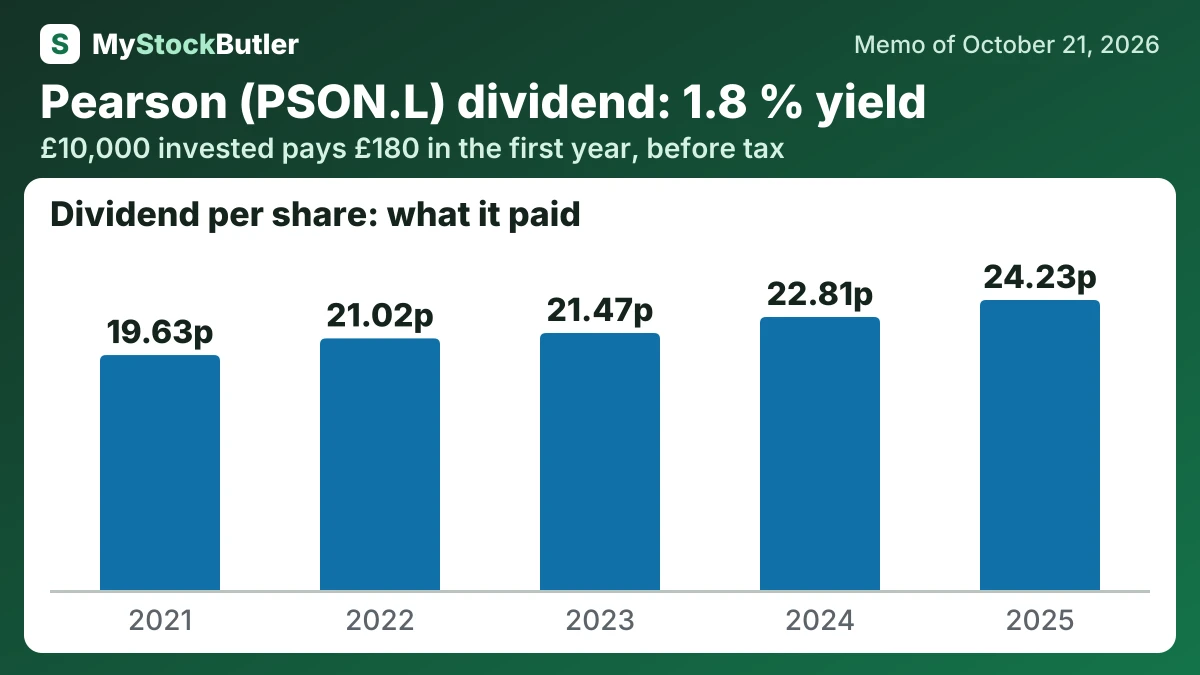
The dividend starts from 25.6p for 2026. That combines the 8.2p interim payment with an estimated 17.4p final payment. The base case grows DPS by about 5% a year, reaching 26.5p, 27.8p and 29.2p. The bear case holds it at 25.6p, while the bull case reaches 27.2p, 29.1p and 31.1p. The base reflects a five-year record of increases and management’s progressive policy, tempered by debt and cash demands.
| 2025 | 2024 | 2023 | 2022 | 2021 | |
|---|---|---|---|---|---|
| EPS, diluted | 50.70 | 63.50 | 52.70 | 32.60 | 23.30 |
| Real free cash flow per share | 77.39 | 69.01 | 51.72 | 23.72 | 19.23 |
| − Dividends paid, per share | 24.23 | 22.81 | 21.47 | 21.02 | 19.63 |
| − Share buybacks, per share | 53.31 | 46.49 | 25.93 | 47.57 | 0.00 |
What this means. Pearson's own free cash flow per share is higher because it uses a different cash calculation and does not subtract the value of shares given to employees as pay; our figure does.
How much would Pearson's dividend pay you?
£10,000 invested in Pearson at its 1.8% dividend yield (our report of October 21, 2026) pays £180.00 in the first year, before tax. If its dividend per share keeps changing 5.4% a year, as it did from 2021 to 2025, and the dividends are reinvested, year 10 pays £352.91, with £2,561.37 received in all.
Before tax. Past dividend growth is not a promise. Information only, not investment advice.
Is Pearson's dividend covered by its cash?
Free cash flow is the cash left after operating needs and investment. Pearson generated £527 million in 2025 and paid £160 million in dividends, but cash quality still matters. A delayed supplier payment, a one-off insurance settlement and a £97 million State Aid tax refund plus £17 million of associated interest can improve cash temporarily without improving the business’s earning power. The dividend must also compete with buybacks and acquisitions, while a UK ten-year government bond yielded 5.40% on October 21, 2026.
Most of the improvement went to shareholders through dividends and buybacks. A dividend pays owners cash; a buyback reduces the number of shares sharing future earnings. Across the five-year period, distributions exceeded the stated free cash flow, while acquisitions continued. Asset sales and existing cash helped fund that combination, leaving less internally generated money for new purchases or debt reduction.
| 2025 | 2024 | 2023 | 2022 | 2021 | |
|---|---|---|---|---|---|
| Free cash flow | 550 | 516 | 411 | 211 | 174 |
| − Dividends paid | 160 | 156 | 154 | 156 | 149 |
| − Share buybacks | 352 | 318 | 186 | 353 | 0 |
| = Free cash flow not paid out | 38 | 42 | 71 | 25 | |
| = Paid out more than the free cash flow | 299 | ||||
| Paid to shareholders | 512 | 474 | 340 | 509 | 149 |
What this means. The company's own net debt differs because it includes lease obligations, derivative contracts, and finance lease amounts, while our count leaves out lease obligations.
What could change Pearson's dividend?
Finally, cash conversion and debt will determine whether Pearson can sustain buybacks while investing. Paid, repeat employer programmes and stronger operating cash would support the bull assumptions; constrained cash would leave the share count higher and the multiple lower.
What is Pearson's dividend yield today?
| Today (Oct 21, 2026) | |
|---|---|
| Share price | 1,369.00 |
| Free cash flow yield (calculated) | 6.7% |
| Dividend yield (calculated) | 1.8% |
What this means. The next-twelve-month earnings figure uses analysts’ guesses about future profit, so it is not guaranteed.