PulteGroup dividend history and cash flow
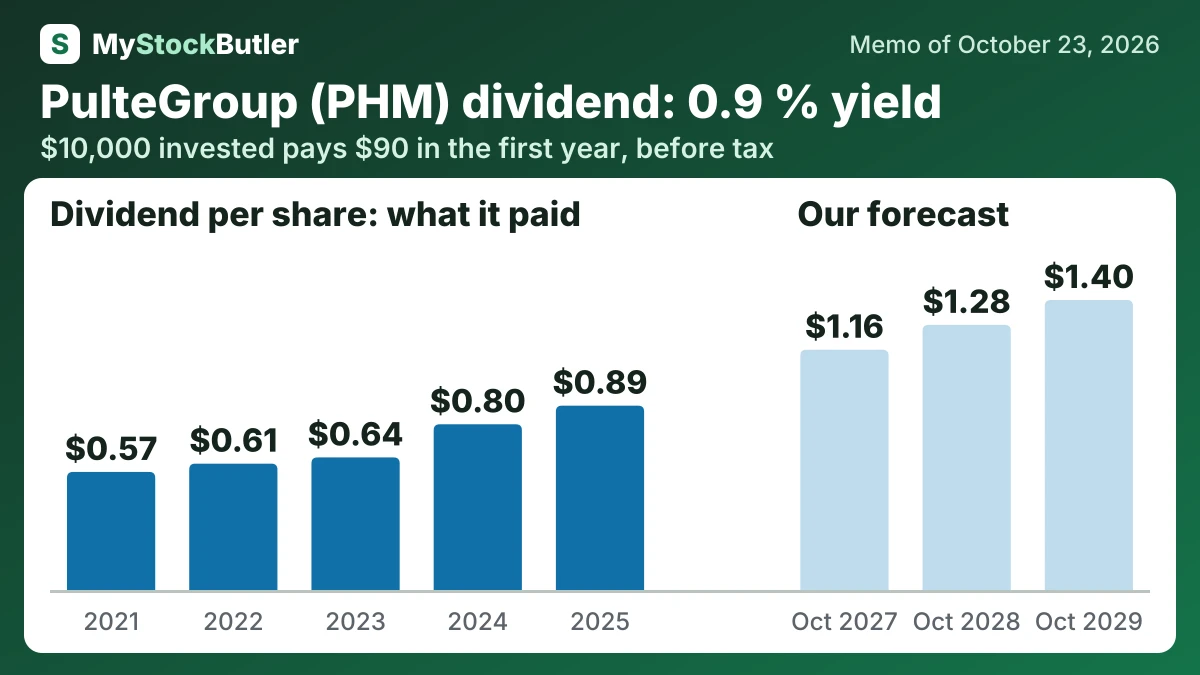
MyStockButler's October 2026 analysis: PulteGroup's base-case dividend is $1.16, $1.28 and $1.40 per share, with the history table showing the earlier payments. PulteGroup's cash coverage varies with its cyclical free cash flow: shareholder payouts exceeded free cash flow in 2022 and 2021.
How much does PulteGroup pay per share?
The numbers show a clear turn: operating margin fell from 21.7% in 2024 to 17.3% in 2025 as home economics weakened. Revenue, closings and net orders also declined in 2025 despite a larger community base. The company’s own free cash flow is cyclical, while buybacks can support EPS as profit weakens; shareholder payouts exceeded free cash flow in 2022 and 2021.
| 2025 | 2024 | 2023 | 2022 | 2021 | |
|---|---|---|---|---|---|
| Free cash flow per share | 8.76 | 7.45 | 9.52 | 2.35 | 3.58 |
| − Dividends paid, per share | 0.89 | 0.80 | 0.64 | 0.61 | 0.57 |
| − Share buybacks, per share | 6.01 | 5.72 | 4.52 | 4.55 | 3.45 |
| = FCF not paid out, per share | 1.86 | 0.93 | 4.35 |
What this means. Real free cash flow per share is lower because it subtracts the value of shares given to employees as pay, treating that pay as a cost to shareholders.
How much would PulteGroup's dividend pay you?
$10,000 invested in PulteGroup at its 0.9% dividend yield (our report of October 23, 2026) pays $90.00 in the first year, before tax. If its dividend per share keeps changing 11.8% a year, as it did from 2021 to 2025, and the dividends are reinvested, year 10 pays $279.53, with $1,676.22 received in all.
Before tax. Past dividend growth is not a promise. Information only, not investment advice.
Does PulteGroup's dividend come from its cash?
Free cash flow means cash from operations after capital expenditure. It can swing because land purchases and home closings do not happen evenly. A buyback may look aggressive in a year when inventory absorbs cash, then comfortably funded when closings release it. The right test is whether cash retained across the cycle replenishes years of shortfall.
Pulte’s recent discretionary cash mainly went to buybacks and dividends. Repurchases reduce the share count and increase each remaining share’s claim on future earnings, but only if Pulte does not overpay or neglect better uses for the money. Debt repayment also mattered, while acquisitions were a minor use in the five-year record. The board authorized another $1.5 billion of repurchases in 2026, but authorization is discretion, not an obligation.
| 2025 | 2024 | 2023 | 2022 | 2021 | |
|---|---|---|---|---|---|
| Free cash flow | 1,748,533 | 1,562,249 | 2,104,561 | 555,805 | 931,240 |
| − Dividends paid | 176,684 | 167,707 | 142,459 | 144,115 | 147,834 |
| − Share buybacks | 1,199,996 | 1,199,999 | 1,000,000 | 1,074,673 | 897,303 |
| = Free cash flow not paid out | 371,853 | 194,543 | 962,102 | ||
| = Paid out more than the free cash flow | 662,983 | 113,897 | |||
| Paid out, % of free cash flow | 78.7% | 87.5% | 54.3% | 219.3% | 112.2% |
What this means. The company’s reported net debt is not directly comparable to the other figures because it leaves out Financial Services debt but includes that business’s cash; a negative number means reported net cash, not that the company has no debt.
What could change PulteGroup's dividend?
Dividends in the base case are $1.16, $1.28 and $1.40 per share, implying quarterly payments of $0.29, $0.32 and $0.35. The bear case falls from $1.04 to $0.96 and then $0.88; the bull case rises from $1.20 to $1.40 and then $1.60. The base reflects a history of annual increases, but the bear case recognizes that land spending was forecast at $5.3 billion.
| October 2027 | October 2028 | October 2029 | |
|---|---|---|---|
| Normal operating profit | 2,754 (2,480 / 3,192) | 3,192 (2,525 / 3,780) | 3,460 (2,916 / 4,224) |
| Shares (millions) | 176 (180 / 173) | 169 (176 / 163) | 162 (173 / 154) |
| Dividends per share | 1.16 (1.04 / 1.20) | 1.28 (0.96 / 1.40) | 1.40 (0.88 / 1.60) |
| Net debt | 257 (345 / 179) | -446 (-3.00 / -650) | -1,491 (-862 / -1,895) |
What this means. Negative net debt means the company has more cash than it owes.
What is PulteGroup's dividend yield against its price?
Cash-flow yield has the same limitation. A builder may collect cash when homes close after spending heavily on land months or years earlier. In 2025, operations generated $1.9 billion while inventory absorbed $213.4 million. Capital spending was another $122.7 million. The resulting yield is therefore not a fixed coupon; the “real” version deducts stock compensation from free cash flow.