Omnicom dividend: cash cover and yield
MyStockButler's October 2026 analysis: Omnicom pays $3.20 per share in every forecast case; the declared quarterly payment is $0.80, after a recent increase from $2.90. Across 2021–2025, Omnicom generated $7,852.7 million of free cash flow and paid $2,838.4 million in dividends, while gross cash repurchases totaled $2,788.1 million.
How much does Omnicom pay per share over time?
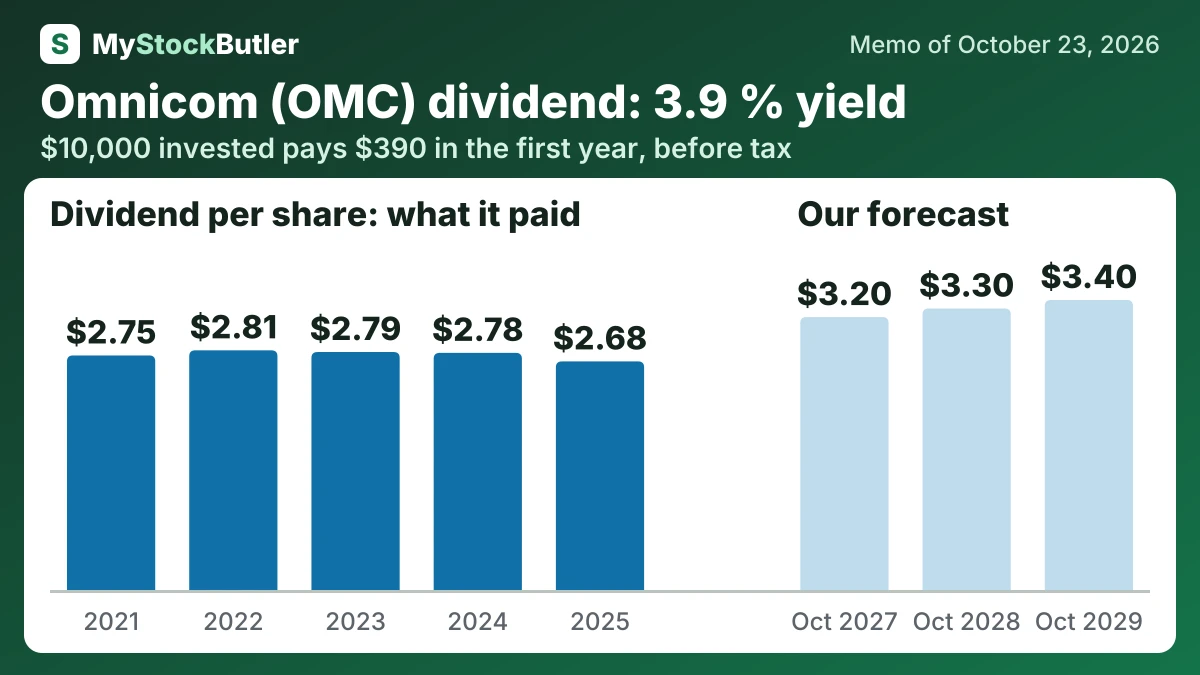
The dividend starts at $3.20 in every case because the declared quarterly payment is $0.80. The base case rises to $3.30 and $3.40; the bear case stays at $3.20; and the bull case reaches $3.40 and $3.60. The base assumes gradual savings-led cash improvement, while the bear reflects integration demands and weak conversion. The recent increase from $2.90 supports measured growth but not aggressive increases.
| October 2027 | October 2028 | October 2029 | |
|---|---|---|---|
| Earnings | 3,198 (2,260 / 3,500) | 3,549 (2,392 / 4,000) | 3,899 (2,554 / 4,500) |
| Shares (millions) | 253 (253 / 253) | 248 (254 / 243) | 244 (255 / 235) |
| Dividends per share | 3.20 (3.20 / 3.20) | 3.30 (3.20 / 3.40) | 3.40 (3.20 / 3.60) |
| Price to earnings | 8.00 (7.00 / 10.00) | 8.00 (6.00 / 11.00) | 8.00 (5.00 / 12.00) |
How much would Omnicom's dividend pay you?
$10,000 invested in Omnicom at its 3.9% dividend yield (our report of October 23, 2026) pays $390.00 in the first year, before tax. If its dividend per share keeps changing −0.6% a year, as it did from 2021 to 2025, and the dividends are reinvested, year 10 pays $514.86, with $4,505.02 received in all.
Before tax. Past dividend growth is not a promise. Information only, not investment advice.
Is Omnicom's dividend covered by its cash?
Across 2021–2025, free cash flow totaled $7,852.7 million. Dividends paid $2,838.4 million, and payments to minority owners absorbed another $431.8 million. Minority owners hold parts of Omnicom’s subsidiaries, so those payments cannot go to Omnicom’s own shareholders.
Omnicom’s physical investment remained modest: capital expenditure rose from $78.4 million in 2023 to $149.8 million in 2025. Gross cash repurchases totaled $2,788.1 million across 2021–2025. Those purchases reduced the share count, so diluted shares fell 1.4% in 2024 and earnings per share benefited mechanically.
| 2025 | 2024 | 2023 | 2022 | 2021 | |
|---|---|---|---|---|---|
| Free cash flow | 2,788.4 | 1,592.9 | 1,343.5 | 848.3 | 1,279.6 |
| − Paid to minority owners | 82.9 | 85.4 | 70.9 | 79.5 | 113.1 |
| − Dividends paid | 549.6 | 552.7 | 562.7 | 581.1 | 592.3 |
| − Acquisitions | 902.1 | 93.3 | 276.8 | 160.0 | |
| − Investments bought | 0 | 0 | 0 | 61.4 | 0 |
| − Debt repaid | 42.0 | 750.0 | 8.7 | 0 | 1,250.0 |
What this means. The company's own net debt is lower because it leaves out finance leases, while our count includes them as debt.
What could change Omnicom's dividend?
The December 31, 2026 results should show whether the $900 million savings target arrived and what integration spending accompanied it. By April 2027, the repurchase program must be assessed with cash and debt, not share-count reduction alone. By 2028, the $1.5 billion ambition must produce recurring profit without weakening client relationships. Omni matters only when adoption expands or renews work and improves cash generation. IPG savings must become durable earnings while clients, talent and cash hold.
What is Omnicom's dividend yield at the share price?
At $82.89 and 7.1x forward earnings, the arithmetic implies about $11.67 of earnings per share over the next twelve months. That is a calculation from the quoted multiple, not company guidance. The gap from the roughly $1.79 implied by the trailing multiple reflects merger effects, accounting adjustments and changing share counts, not ordinary operating growth.
| Today (Oct 23, 2026) | |
|---|---|
| Share price | 82.89 |
| Market value (calculated) | 22,616.3 |
| Free cash flow yield (calculated) | 12.3% |
| Real free cash flow yield (calculated) | 11.9% |
| Dividend yield (calculated) | 3.9% |
What this means. The next 12 months price-to-earnings ratio is much lower because it uses analysts' expected profit instead of profit already earned.