DuPont stock forecast 2027–2029
MyStockButler's October 2026 analysis: DuPont’s weighted forecast puts the price at $134.61 in October 2027. It hinges on water-project delivery, margin improvement and cash generation sufficient to support payouts.
Where could DuPont’s shares be by 2029?
The weighted forecast puts the price at $134.61 in October 2027, with a +0% total return. By October 2029, it reaches $148.64, with a +14% total return. The bear case carries 30% probability. Base is 50%, and bull is 20%.
The range is much wider than the weighted result. October 2029 runs from $97.17 in the bear case to $217.18 in the bull case. The current price is $136.55, so the forecast is balanced between capital preservation and substantial upside. The probabilities are 30% bear, 50% base and 20% bull.
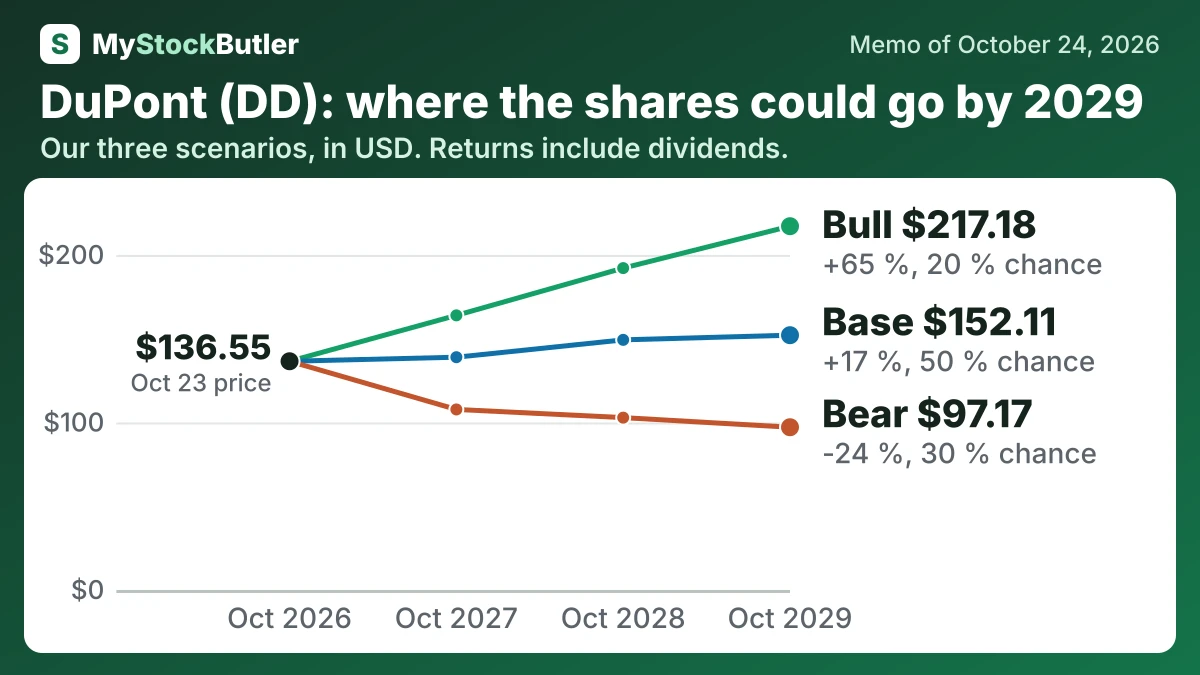
| Case | Probability | October 2027 | October 2028 | October 2029 |
|---|---|---|---|---|
| Bear | 30 % | 107.78 (-19 %) | 102.90 (-22 %) | 97.17 (-24 %) |
| Base | 50 % | 138.97 (+4 %) | 149.33 (+13 %) | 152.11 (+17 %) |
| Bull | 20 % | 163.95 (+22 %) | 192.17 (+44 %) | 217.18 (+65 %) |
| Weighted | 100 % | 134.61 (+0 %) | 143.97 (+9 %) | 148.64 (+14 %) |
What has to go right or wrong for DuPont?
NAV is the forecast’s first judgment. The base case rises from the latest reported equity to $14,490 million by October 2029. The bear case ends at $13,440 million, while the bull case reaches $15,240 million. The base assumes improving earnings, continued payouts and no material uplift to the private Arclin valuation. The bear case reflects weak demand, margin pressure and payouts that exceed earnings; the bull case assumes stronger volume, mix and productivity.
The bull case requires repeat water orders, timely project delivery, industrial recovery and several years of stronger cash generation. That supports larger buybacks, dividend growth and a higher multiple. The path rises from $163.95 to $217.18, but receives only a 20% probability because its buybacks exceed the announced authorization and depend on renewed approval.
How much cash does DuPont really make?
Stock compensation adds another owner-level adjustment. It uses no current cash, but it gives employees a claim on the business. Deducting it produces a stricter analytical measure of free cash flow. The specialist follows all three views because working-capital releases and transaction add-backs may not persist.
| 2025 | 2024 | 2023 | |
|---|---|---|---|
| Cash from operations | 560 | 765 | 845 |
| − Capital spending | 333 | 285 | 302 |
| = Free cash flow | 227 | 480 | 543 |
| − Stock pay | 38 | 56 | 57 |
| = Real free cash flow | 189 | 424 | 486 |
| Free cash flow, % of revenue | 3.3% | 7.1% | 8.2% |
What this means. The company's own free cash flow is much higher because it adds back separation-related transaction costs and other payments that we count as cash spent.
What does an investor pay for DuPont today?
| Today (Oct 24, 2026) | |
|---|---|
| Share price | 136.55 |
| Market value (calculated) | 18,440.12 |
| Enterprise value (calculated) | 19,825.12 |
| P/E, last 12 months (calculated) | 58.4x |
| Free cash flow yield (calculated) | 1.2% |
| Real free cash flow yield (calculated) | 1.0% |