Copart stock forecast 2027–2029
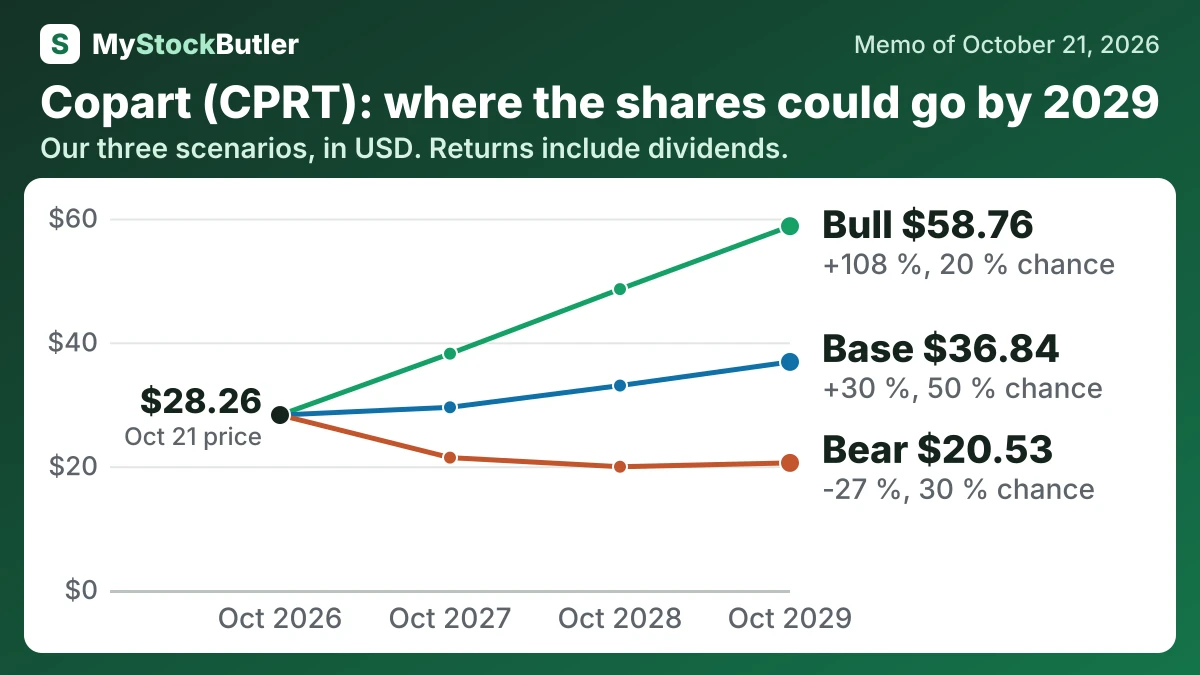
MyStockButler's October 2026 analysis: Copart’s weighted price could reach $36.33 by October 2029, a 29% return, if insurance supply stabilizes, margins recover and ACV adds value. Copart’s case rests on insurance supply and margins recovering while ACV proves its value after integration costs.
Where could Copart’s shares be by 2029?
At October 2027, the weighted price is $28.80, a 2% return including dividends. At October 2028, it reaches $32.20, a 14% return. At October 2029, it reaches $36.33, a 29% return.
The bear case has a 30% probability. The base case has a 50% probability. The bull case has a 20% probability.
| Case | Probability | October 2027 | October 2028 | October 2029 |
|---|---|---|---|---|
| Bear | 30 % | 21.38 (-24 %) | 19.91 (-30 %) | 20.53 (-27 %) |
| Base | 50 % | 29.51 (+4 %) | 33.02 (+17 %) | 36.84 (+30 %) |
| Bull | 20 % | 38.17 (+35 %) | 48.60 (+72 %) | 58.76 (+108 %) |
| Weighted | 100 % | 28.80 (+2 %) | 32.20 (+14 %) | 36.33 (+29 %) |
What this means. The weighted row is the probability-based average of the bear, base, and bull cases, not a separate prediction that will happen on its own.
What has to go right for Copart, and what could go wrong?
The bear case requires weak insurer assignments, persistent customer losses and costly ACV integration.
The bull case requires stronger total-loss conversion, retained insurer accounts, successful dealer cross-selling and sustained repurchases. It reaches $38.17 by October 2027 and $58.76 by October 2029. Its 20% probability reflects the number of conditions that must succeed together, while management has supplied no numerical earnings or integration guidance.
How much cash does Copart really make?
Operating cash flow follows money collected and paid, while profit follows accounting recognition. Free cash flow subtracts capital spending from operating cash flow. Deducting stock-based compensation produces “real free cash flow,” an analytical convention that recognises dilution even though the award itself does not immediately use cash.
| Jul 2026 | Jul 2025 | Jul 2024 | Jul 2023 | Jul 2022 | |
|---|---|---|---|---|---|
| = Free cash flow | 1,267,129 | 1,230,760 | 961,574 | 847,574 | 839,235 |
| − Stock pay | 38,818 | 38,004 | 35,234 | 39,673 | 38,965 |
| = Real free cash flow | 1,228,311 | 1,192,756 | 926,340 | 807,901 | 800,270 |
| Free cash flow, % of revenue | 27.2% | 26.5% | 22.7% | 21.9% | 24.0% |
| Real free cash flow, % of revenue | 26.3% | 25.7% | 21.9% | 20.9% | 22.9% |
What this means. The working capital line includes taxes, long-term operating assets, leases, and other items—not just inventory and unpaid customer bills—so it is a broad cash adjustment.
What does an investor pay for Copart today?
| Today (Oct 21, 2026) | |
|---|---|
| Share price | 28.2554 |
| P/E, last 12 months (calculated) | 18.2x |
| P/E, next 12 months (calculated) | 17.4x |
| Free cash flow yield (calculated) | 4.8% |
| Real free cash flow yield (calculated) | 4.7% |
| Dividend yield (calculated) | 0.0% |
What this means. The enterprise value may be too low because it uses an older balance sheet and does not include cash paid for the October 16 acquisition.