Ball stock forecast 2027–2029
MyStockButler's October 2026 analysis: Ball’s weighted value reaches $84.88 in October 2029. It hinges on shipment growth, utilization and cash conversion.
Where could Ball’s shares be in October 2029?
By October 2029, the weighted value reaches $84.88, or a 35% return. The bear-to-bull range then runs from $46.68 to $134.85. Today’s price is $64.76.
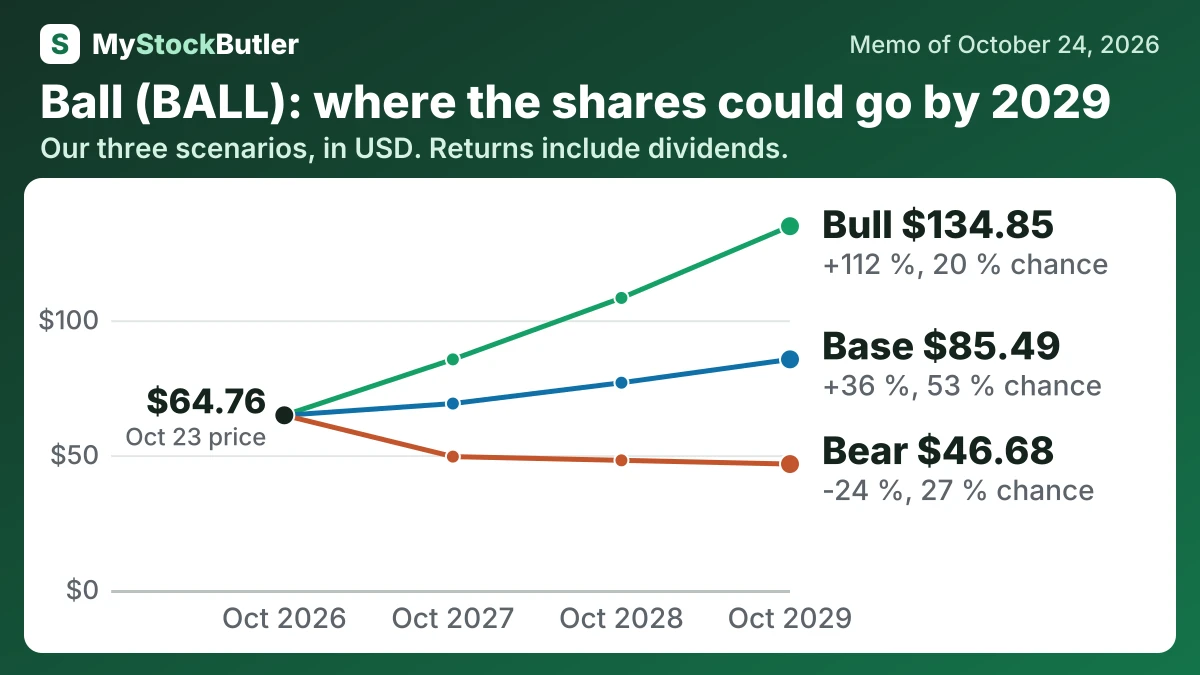
| Case | Probability | October 2027 | October 2028 | October 2029 |
|---|---|---|---|---|
| Bear | 27 % | 49.44 (-22 %) | 48.06 (-23 %) | 46.68 (-24 %) |
| Base | 53 % | 69.11 (+8 %) | 76.83 (+21 %) | 85.49 (+36 %) |
| Bull | 20 % | 85.48 (+33 %) | 108.26 (+70 %) | 134.85 (+112 %) |
| Weighted | 100 % | 67.07 (+5 %) | 75.35 (+19 %) | 84.88 (+35 %) |
What this means. The weighted row is the average value after giving each case more or less weight based on how likely it is.
What has to go right for Ball, and what could go wrong?
The bear case reflects North American comparable earnings falling despite volume growth and gross margin declining from 19.4% to 17.4%. Management also expects $35 million of 2026 start-up costs. The bull case requires those pressures to reverse as utilization improves and Benepack integrates successfully. First-half free cash flow was negative $471 million after working capital absorbed $1.012 billion, so the bull margin path requires stronger cash conversion as well.
During 2027 and 2028, Millersburg utilization, profit per can and operating margin will decide whether the base improvement occurs. Persistent start-up friction would support the bear case; efficient ramp-up and recurring savings would support the bull case.
| October 2027 | October 2028 | October 2029 | |
|---|---|---|---|
| Earnings | 1,110 (950 / 1,210) | 1,200 (980 / 1,400) | 1,300 (1,020 / 1,600) |
| Shares (millions) | 257 (259 / 255) | 250 (255 / 246) | 243 (251 / 237) |
| Dividends per share | 0.80 (0.80 / 0.84) | 0.84 (0.80 / 0.88) | 0.88 (0.64 / 0.92) |
| Price to earnings | 16.00 (13.50 / 18.00) | 16.00 (12.50 / 19.00) | 16.00 (11.50 / 20.00) |
How much cash does Ball really make?
Operating cash flow exceeded capital spending in 2025, leaving positive free cash flow. The table separates operations, working capital, investment, stock pay and Ball’s own free-cash-flow count.
| 2025 | 2024 | 2023 | |
|---|---|---|---|
| Cash from operations | 1,262 | ||
| − Capital spending | 474 | 471 | 939 |
| = Free cash flow | 788 | ||
| − Stock pay | 28 | 56 | 29 |
| = Real free cash flow | 760 |
What this means. The company's own free cash flow is 788, but our real free cash flow is 760 because shares given to employees as pay reduce shareholders' ownership even though no cash was paid.
What does an investor pay for Ball today?
The trailing P/E is 18.4x, while the next-12-month P/E is 16.1x. P/E compares the share price with the earnings attributed to each share, so the lower forward multiple assumes that earnings will rise. That denominator must represent the continuing packaging business: aerospace was sold in February 2024, and disposal gains cannot produce future packaging profits.