Viatris stock forecast 2027–2029
MyStockButler's October 2026 analysis: Viatris's weighted scenario is $21.44 by October 2029, with the base case carrying a 54% probability. Viatris's outlook hinges on converting a disrupted, shrinking portfolio into durable cash generation.
Where could Viatris's shares be by October 2029?
The forecast expects a weak first year followed by moderate appreciation. The weighted price is $17.83 in October 2027 and $19.27 in October 2028. It reaches $21.44 in October 2029. Including dividends, those outcomes represent a return of -1% and +9% in the first two years. The October 2029 return is +23%.
The range remains unusually wide. By October 2029, the bear case reaches $8.78, while the bull case reaches $35.62. Today’s reference price is $18.48. The probabilities are 27% for the bear case, 54% for the base case and 19% for the bull case.
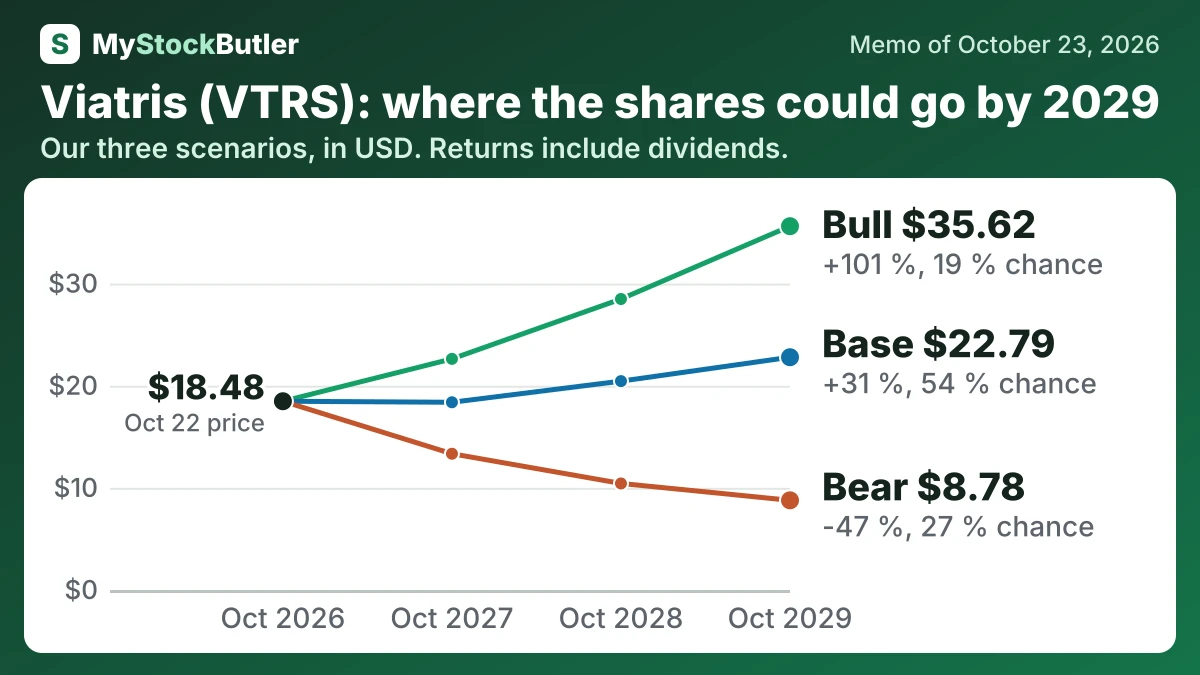
| Case | Probability | October 2027 | October 2028 | October 2029 |
|---|---|---|---|---|
| Bear | 27 % | 13.34 (-25 %) | 10.43 (-39 %) | 8.78 (-47 %) |
| Base | 54 % | 18.38 (+2 %) | 20.45 (+16 %) | 22.79 (+31 %) |
| Bull | 19 % | 22.63 (+25 %) | 28.49 (+60 %) | 35.62 (+101 %) |
| Weighted | 100 % | 17.83 (-1 %) | 19.27 (+9 %) | 21.44 (+23 %) |
What this means. The weighted row is the probability-based average of the bear, base, and bull outcomes, not a guaranteed share price.
What has to go right for Viatris, and what could go wrong?
The bear case falls from $2,574 million to $2,295 million because erosion and supply problems push revenue and margins below the 2025 adjusted margin of about 19.4%. The bull case rises from $3,192 million to $3,910 million as supply recovers, complex products gain traction, margins reach 23.0% and Pacira contributes. The base receives the greatest weight because 2026 guidance implies adjusted earnings near $2.9–$3.0 billion, while the June quarter delivered 4.9% revenue growth; however, adjusted earnings declined each year from 2022 through 2025.
How much cash does Viatris really make?
Stock compensation needs a further adjustment. It pays employees with shares rather than immediate cash. If a company has 100 shares and issues 2 to employees, the bank balance is unchanged but existing shareholders own a smaller fraction. Subtracting stock pay from free cash flow therefore gives a stricter estimate of cash available to them.
| 2025 | 2024 | 2023 | 2022 | 2021 | |
|---|---|---|---|---|---|
| Cash from operations | 2,315.9 | 2,302.9 | 2,900.0 | 2,999.0 | 3,016.9 |
| − Capital spending | 378.8 | 326.0 | 377.0 | 406.0 | 457.2 |
| = Free cash flow | 1,937.1 | 1,976.9 | 2,523.0 | 2,593.0 | 2,559.7 |
| − Stock pay | 177.7 | 146.1 | 180.7 | 116.4 | 111.2 |
| = Real free cash flow | 1,759.4 | 1,830.8 | 2,342.3 | 2,476.6 | 2,448.5 |
What this means. In 2022, the company's free cash flow is 46.4 million lower because its older published count subtracts a cash item that our consistent calculation leaves in.
What does an investor pay for Viatris today?
A forward P/E compares the share price with expected earnings; a trailing P/E uses earnings already reported. Adjusted EBITDA is operating profit before interest, taxes, depreciation and amortization, with further items removed by management. Viatris’s 2026 adjusted EBITDA midpoint is $4,400 million. That measure helps compare operations, but it excludes interest, taxes, factory investment and selected costs. Amortization spreads the cost of acquired medicine rights over time, while impairment records that an acquired asset is worth less. Neither charge necessarily uses cash immediately, but both reflect money invested in the portfolio.
| Today (Oct 22, 2026) | |
|---|---|
| Share price | 18.48 |
| Market value (calculated) | 21,226.0 |
| Enterprise value (calculated) | 33,168.3 |
| P/E, last 12 months (calculated) | not meaningful |
| P/E, next 12 months (calculated) | 6.8x |
| Free cash flow yield (calculated) | 9.1% |