Tapestry stock forecast 2027–2029
MyStockButler's October 2026 analysis: The weighted case reaches $118.80 in October 2027, with 55% assigned to the base case, 28% to bear and 17% to bull. It hinges on Coach sustaining growth and Kate Spade stabilizing.
Where could Tapestry's shares be by 2029?
The verdict is moderate upside: the weighted case reaches $118.80 in October 2027, a 6% total return, if Coach sustains growth and Kate Spade stabilizes. Management guides FY2027 revenue to $8.4–$8.5 billion. Adjusted diluted EPS guidance is $7.80–$7.90. It targets a 24.0% operating margin, including 50 basis points of expansion. Adjusted free cash flow target is $1,700.0 million. Planned shareholder returns total $1,700.0 million, including $1,350.0 million of repurchases. The five-year guidance score is 3/5. EPS hurdles were met in all five years, while revenue finished below its initial target three times.
The weighted case assigns 28% to the bear case and 55% to the base case. The bull case carries 17%. By October 2029, weighted price reaches $155.16, a 42% total return. The November 5, 2026 fiscal first-quarter report tests demand, Kate Spade’s decline and inventory against the $1.55 adjusted EPS forecast. Several seasons of healthy Coach units, AUR and full-price sell-through support the upside cases. The investment works only if Coach keeps growing, Kate Spade stabilizes and cash generation proves repeatable.
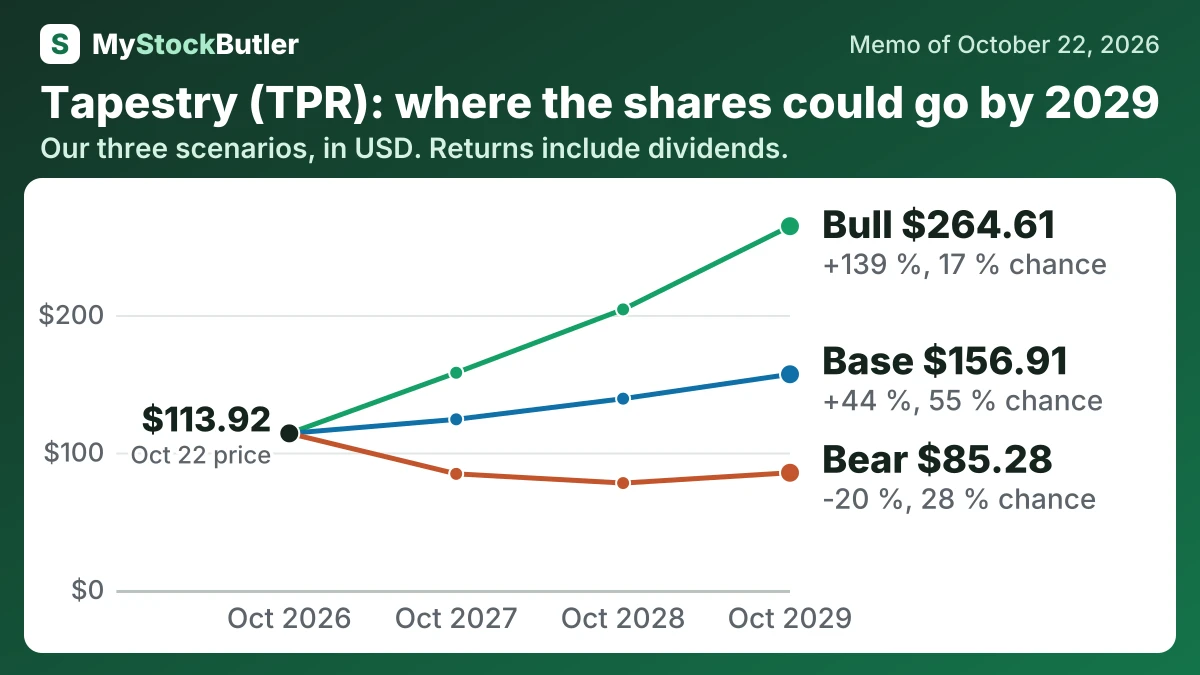
| Case | Probability | October 2027 | October 2028 | October 2029 |
|---|---|---|---|---|
| Bear | 28 % | 84.49 (-24 %) | 77.77 (-28 %) | 85.28 (-20 %) |
| Base | 55 % | 124.14 (+11 %) | 139.17 (+26 %) | 156.91 (+44 %) |
| Bull | 17 % | 158.01 (+40 %) | 204.09 (+83 %) | 264.61 (+139 %) |
| Weighted | 100 % | 118.80 (+6 %) | 133.01 (+21 %) | 155.16 (+42 %) |
What this means. The weighted value is the average of the bear, base, and bull cases based on their probabilities, not a promise that the share price will reach it.
What has to go right for Tapestry, and what could go wrong?
The base path follows strong FY2026 adjusted earnings, Coach’s 23.5% revenue growth and management’s expectation of double-digit EPS growth. The bear case assumes Coach slows, Kate Spade remains loss-making and margins retreat. The bull case requires sustained Coach unit and price growth, Kate Spade stabilization and productive international expansion.
How much cash does Tapestry really make?
Operating cash flow was $1,978.5 million in FY2026. After $166.0 million of capital spending, free cash flow was $1,812.5 million. Deducting $104.5 million of stock compensation produces $1,708.0 million of real free cash flow, because shares given to employees still impose an economic cost through dilution or repurchases.
| Jun 2026 | Jun 2025 | Jun 2024 | Jul 2023 | Jul 2022 | |
|---|---|---|---|---|---|
| Cash from operations | 1,978.5 | 1,216.6 | 1,255.6 | 975.2 | 853.2 |
| − Capital spending | 166.0 | 122.7 | 108.9 | 184.2 | 93.9 |
| = Free cash flow | 1,812.5 | 1,093.9 | 1,146.7 | 791.0 | 759.3 |
| − Stock pay | 104.5 | 87.3 | 85.9 | 78.8 | 72.2 |
| = Real free cash flow | 1,708.0 | 1,006.6 | 1,060.8 | 712.2 | 687.1 |
| Real free cash flow, % of revenue | 21.3% | 14.4% | 15.9% | 10.7% | 10.3% |
What does an investor pay for Tapestry today?
The price-to-earnings ratio, or P/E, says how much investors pay for one dollar of annual profit. Fiscal 2026 GAAP earnings were $7.27 per share, versus $7.05 of adjusted earnings. GAAP is the standard accounting result; adjusted earnings remove selected items, but those items can include benefits as well as costs. Fiscal 2026 adjustments reduced full-year EPS by $0.22. Buybacks can also lift EPS because the same profit is divided among fewer shares.
| Today (Oct 22, 2026) | |
|---|---|
| Share price | 113.92 |
| Market value (calculated) | 22,605.8 |
| Enterprise value (calculated) | 23,832.8 |
| P/E, last 12 months (calculated) | 15.6x |
| P/E, next 12 months (calculated) | 14.3x |
| Free cash flow yield (calculated) | 8.0% |
What this means. The next 12 months price-to-earnings number uses analysts' estimates, so it can be wrong if the company's future profit differs from their forecasts.