Ralph Lauren earnings date and guidance
MyStockButler's October 2026 analysis: Ralph Lauren's next results are expected on November 5, 2026. The key thing to watch is whether repeat purchasing and margin improvement survive shipment timing and cost pressures.
What has Ralph Lauren guided for the year?
The guidance in force on October 22, 2026, was raised on August 6, 2026. For Fiscal 2027, Ralph Lauren expects revenue growth of 5.0%–6.0% in constant currency on a comparable 52-week basis. Constant currency freezes exchange rates, so it shows whether the business sold more without a stronger or weaker dollar changing the answer. The 53rd week should add 1.0 percentage point to revenue growth, while currencies should subtract 50–100 basis points.
Management expects constant-currency operating-margin expansion of 60–80 basis points for Fiscal 2027. Operating margin is the share of sales left after merchandise and operating expenses, before interest and tax. The second-quarter guide is stronger, at 80–100 basis points, partly because marketing timing differs from the prior year and tariff costs should be lower in the first half. That early strength does not establish the pace for the full year.
| The period guided | Low | High | The date it was given | |
|---|---|---|---|---|
| Constant currency revenues, 52-week comparable basis (% growth) | Fiscal 2027 | 5.0% | 6.0% | Aug 6, 2026 |
| Foreign currency negative impact on revenue growth (basis points) | Fiscal 2027 | 50 | 100 | Aug 6, 2026 |
| Operating margin expansion in constant currency (basis points) | Fiscal 2027 | 60 | 80 | Aug 6, 2026 |
| 53rd week contribution to revenue growth (percentage points) | Fiscal 2027 | 1.0 | 1.0 | Aug 6, 2026 |
| Tax rate (%) | Fiscal 2027 | 21.0% | 22.0% | Aug 6, 2026 |
| Capital expenditures (% of revenue) | Fiscal 2027 | 4.0% | 5.0% | Aug 6, 2026 |
Has Ralph Lauren kept its past promises?
The operating record has been stronger than the earnings record. Constant-currency revenue and adjusted constant-currency operating margin beat initial guidance in all seven checked quarters. Taxes were less precise, which shows why a strong operating result does not guarantee equally strong earnings: tax and selected unusual charges are deducted later. Adjusted results remove specified charges, so adjusted earnings can also differ from reported earnings.
| What management forecast | Checked | Above | Within | Below |
|---|---|---|---|---|
| Net revenues — constant currency growth | 7 quarters | 7 | 0 | 0 |
| Operating margin — adjusted, constant currency | 7 quarters | 7 | 0 | 0 |
| Tax rate — adjusted effective tax rate | 7 quarters | 3 | 3 | 1 |
What is Ralph Lauren's recent revenue and profit trend?
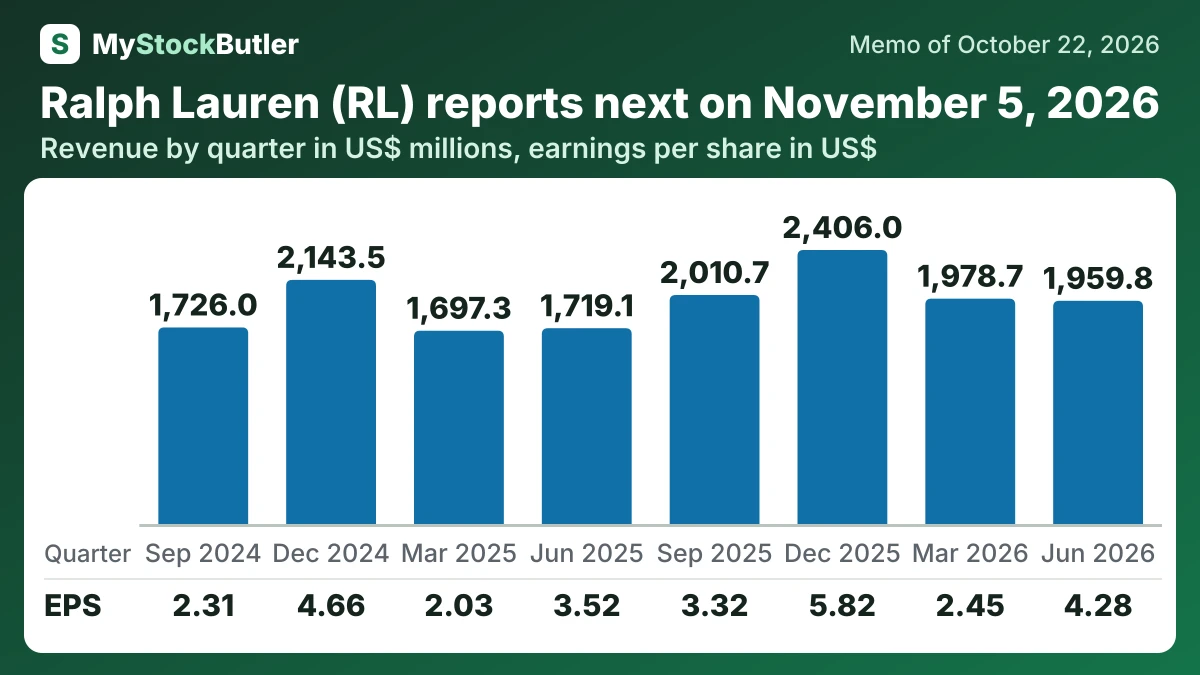
Revenue, gross margin and operating income all improved from the prior-year quarter, continuing the stronger pattern already visible through fiscal 2026. Adjusted operating results also improved, and the small difference between reported and adjusted EPS growth shows that changing exceptional charges explain little of the quarter’s progress.
| Jun 2026 | Mar 2026 | Dec 2025 | Sep 2025 | Jun 2025 | Mar 2025 | Dec 2024 | Sep 2024 | |
|---|---|---|---|---|---|---|---|---|
| Revenue | 1,959.8 | 1,978.7 | 2,406.0 | 2,010.7 | 1,719.1 | 1,697.3 | 2,143.5 | 1,726.0 |
| Gross margin | 73.7% | 69.7% | 69.9% | 68.0% | 72.3% | 68.7% | 68.4% | 67.0% |
| Operating income | 342.4 | 188.6 | 471.3 | 245.7 | 273.6 | 155.0 | 389.7 | 178.9 |
| Net income | 262.2 | 151.6 | 361.6 | 207.5 | 220.4 | 129.0 | 297.4 | 147.9 |
| EPS, diluted | 4.28 | 2.45 | 5.82 | 3.32 | 3.52 | 2.03 | 4.66 | 2.31 |
| = Free cash flow | 285.9 | 93.9 | 704.0 | -40.6 | -11.2 | 42.3 | 677.2 | 55.5 |
What this means. Free cash flow can be negative even when cash from operations is positive because the company spent more on equipment than it generated from daily business.
What should I watch in Ralph Lauren's next results?
Ralph Lauren’s next scheduled checkpoint is November 5, 2026, when it will discuss second-quarter Fiscal 2027 results. The key questions are whether sales came from repeat purchasing, retailer replenishment and existing-store demand, and whether the promised margin improvement survived the quarter’s cost pressures. The holiday quarter will then test full-price demand during an important selling season.