Casey’s earnings date and guidance
MyStockButler's October 2026 analysis: Casey’s next results are expected on December 8, 2026. Watch whether expense growth slows before Casey’s revisits annual guidance.
What has Casey’s guided for the year ending April 30, 2027?
On September 8, 2026, management reaffirmed its outlook for the year ending April 30, 2027: EBITDA growth of 8.0%–10.0% and at least 120 store openings. EBITDA is operating profit before interest, taxes, depreciation, and amortization. It helps compare store operations, but it is not cash: Casey’s must still pay taxes and interest, replace equipment, build stores, and buy businesses.
The existing-store assumptions are modest. Same-store sales compare only locations open throughout both periods, so new stores cannot improve that measure immediately. Inside same-store sales are expected to grow 2.0%–5.0%, with a 42.0% inside margin. In plain terms, each $100 of food, drinks, and merchandise sales leaves about $42 after product costs, before wages and other store expenses. Fuel gallons may range from a decline of 1.0% to growth of 1.0%, so the plan depends more on profit per gallon and shopping visit than on sharply higher fuel demand.
| the period guided | low | high | the date it was given | |
|---|---|---|---|---|
| Inside same-store sales | Year to Apr 2027 | 2.0% | 5.0% | Sep 8, 2026 |
| Inside margin | Year to Apr 2027 | 42.0% | Sep 8, 2026 | |
| Same-store fuel gallons sold | Year to Apr 2027 | -1.0% | 1.0% | Sep 8, 2026 |
| Total operating expenses | Year to Apr 2027 | 5.0% | 7.0% | Sep 8, 2026 |
| EBITDA | Year to Apr 2027 | 8.0% | 10.0% | Sep 8, 2026 |
| Stores | Year to Apr 2027 | 120 | Sep 8, 2026 |
What this means. The earnings before interest, taxes, depreciation, and amortization guidance is not final profit because it leaves out interest, taxes, and some costs of long-lasting assets.
Did Casey’s keep its past promises?
Casey’s delivery record deserves a middle score. Across four checked years, inside same-store sales and fuel gallons each finished above guidance once, within it twice, and below it once. Expenses exceeded guidance in three of the four years. Acquisitions explain some increases because purchased stores bring both earnings and payroll. Other cost increases reflected performance compensation and charitable contributions, while a missing leap day explains part of one sales shortfall. Those explanations matter, but the next question remains whether higher costs buy lasting earning power.
| What management forecast | Checked | Above | Within | Below |
|---|---|---|---|---|
| Inside same-store sales | 4 years | 1 | 2 | 1 |
| Same-store fuel gallons sold | 4 years | 1 | 2 | 1 |
| Total operating expenses | 4 years | 3 | 0 | 1 |
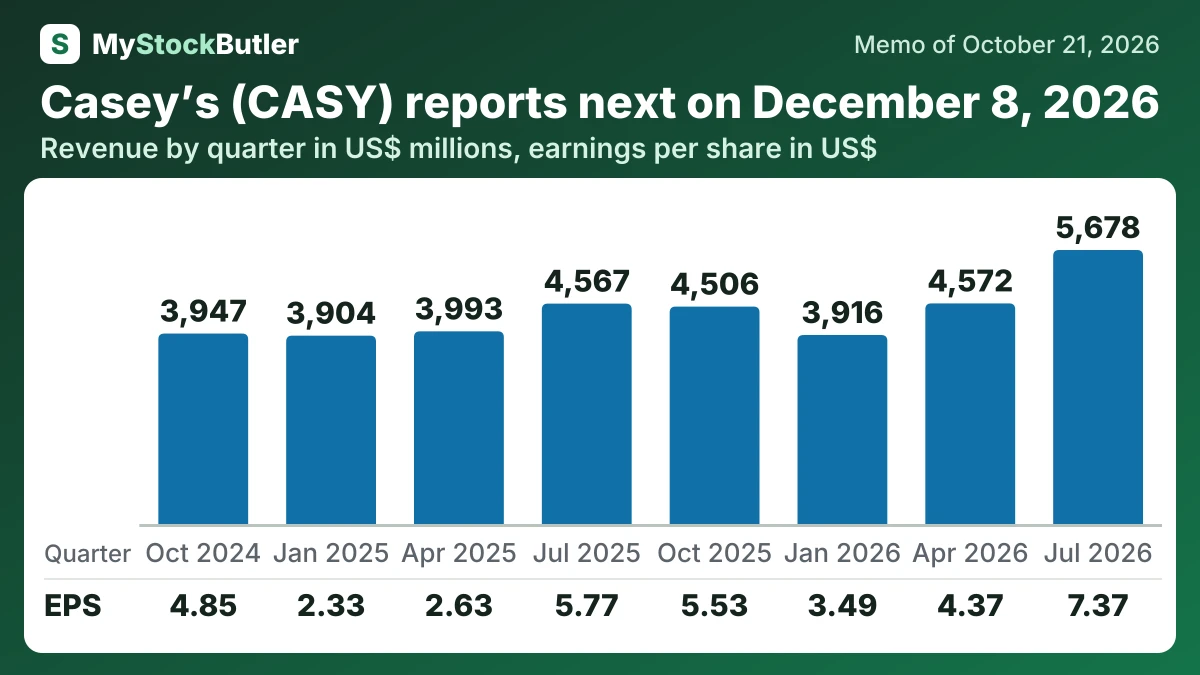
What is Casey’s revenue and profit trend across the last eight quarters?
Cash was less spectacular than earnings. Operating cash flow rose from $372.417 million to $384.072 million, but capital spending rose from $110.046 million to $194.395 million. Free cash flow consequently fell from $262.371 million to $189.677 million. The tax rate also fell from 22.7% to 21.1%, helping net income grow faster than operating income.
| Jul 2026 | Apr 2026 | Jan 2026 | Oct 2025 | Jul 2025 | Apr 2025 | Jan 2025 | Oct 2024 | |
|---|---|---|---|---|---|---|---|---|
| Revenue | 5,678,336 | 4,571,779 | 3,916,132 | 4,506,084 | 4,567,106 | 3,992,758 | 3,903,633 | 3,946,771 |
| Operating income | 369,089 | 234,839 | 194,828 | 298,683 | 305,307 | 155,574 | 137,165 | 252,288 |
| Net income | 273,720 | 162,684 | 130,073 | 206,336 | 215,355 | 98,307 | 87,097 | 180,918 |
| EPS, diluted | 7.37 | 4.37 | 3.49 | 5.53 | 5.77 | 2.63 | 2.33 | 4.85 |
| = Free cash flow | 189,677 | 207,428 | 75,806 | 176,015 | 262,371 | 153,133 | 90,666 | 160,041 |
What this means. The cash from operations numbers are for each quarter alone, even though some are calculated by subtracting earlier year-to-date totals from later totals.
What should I watch in Casey’s next results?
The quarter ending October 31, 2026 is the next operating checkpoint, after which management said it intended to revisit annual guidance. Casey’s earns more sales and profitability during its first and second fiscal quarters, so one excellent summer cannot prove the year. Investors should watch fuel gross profit alongside gallons, then see whether expense growth slows during the January and April quarters.