Galaxy stock forecast 2027–2029
MyStockButler's October 2026 analysis: Galaxy's weighted forecast is HK$32.35 in October 2029. It hinges on whether Galaxy converts Macau’s recovered traffic into durable, luck-normalized cash returns while Phase 4 proves its value.
Where could Galaxy's shares be by October 2029?
The weighted forecast sees limited near-term upside, followed by a gradual recovery. The weighted price is HK$28.60 in October 2027. It reaches HK$30.29 in October 2028 and HK$32.35 in October 2029, versus today’s HK$33.22. The corresponding total returns are negative 9%, positive 1% and positive 12%.
By October 2029, the bear case gives HK$18.74 and the bull case gives HK$47.15. The probabilities are 25% for bear, 55% for base and 20% for bull, so the base path is most likely but the range remains wide.
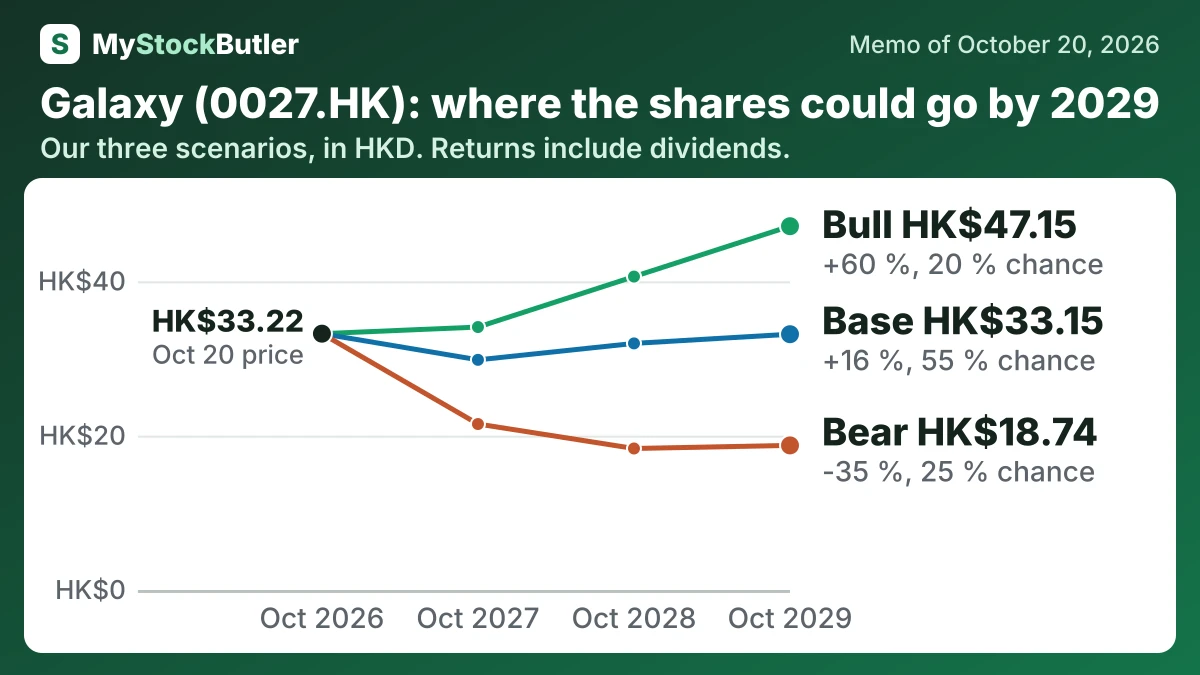
| Case | Probability | October 2027 | October 2028 | October 2029 |
|---|---|---|---|---|
| Bear | 25 % | 21.51 (-32 %) | 18.34 (-38 %) | 18.74 (-35 %) |
| Base | 55 % | 29.83 (-5 %) | 31.96 (+7 %) | 33.15 (+16 %) |
| Bull | 20 % | 34.08 (+8 %) | 40.62 (+34 %) | 47.15 (+60 %) |
| Weighted | 100 % | 28.60 (-9 %) | 30.29 (+1 %) | 32.35 (+12 %) |
What this means. The weighted row is a probability-based average of the bear, base, and bull cases, not a promise that the shares will reach that exact value.
What could make Galaxy's forecast bear, base or bull?
The forecast assumes gradual normalized earnings growth, modest dilution, rising dividends, falling valuation support and rebuilding net cash after the construction peak.
How much cash does Galaxy really make?
Free cash flow deducts capital spending from operating cash. This essay also deducts lease payments and interest paid, then makes a separate economic deduction for stock compensation. That final adjustment is not a company-reported subtotal: stock awards do not use cash immediately, but they transfer value to employees.
| 2025 | 2024 | 2023 | 2022 | 2021 | |
|---|---|---|---|---|---|
| − Capital spending | 3,430.885 | 4,828.078 | 5,959.366 | 5,062.701 | 6,907.668 |
| − Lease payments | 93.639 | 91.384 | 79.461 | 56.365 | 53.35 |
| − Interest paid | 72.212 | 47.232 | 137.385 | 109.008 | 0 |
| = Free cash flow | 10,656.827 | 6,583.569 | 5,417.629 | -8,207.455 | -10,448.231 |
| − Stock pay | 229.454 | 261.373 | 251.279 | 181.19 | 206.043 |
| = Real free cash flow | 10,427.373 | 6,322.196 | 5,166.35 | -8,388.645 | -10,654.274 |
What this means. Real free cash flow is lower because paying employees with shares uses no cash today but gives away part of the company.
What does an investor pay today for Galaxy?
Book value provides another check, but buildings do not guarantee attractive returns. Free cash flow is operating cash after capital spending, and Galaxy’s 7.3% free-cash-flow yield must withstand planned 2026 project spending of HK$5–6 billion. The 4.5% dividend yield shows cash returned today, not cash that remains after every investment claim.
| Today (Oct 20, 2026) | |
|---|---|
| Share price | 33.22 |
| P/E, next 12 months (calculated) | 13.6x |
| Free cash flow yield (calculated) | 7.3% |
| Real free cash flow yield (calculated) | 7.2% |
| Dividend yield (calculated) | 4.5% |
What this means. The enterprise value is lower than the market value because it subtracts the company's cash and short-term investments.